Buzzer Not Working? How Intercom Repair Actually Gets Diagnosed in NYC Buildings
The short answer first
An intercom system has three zones where it can fail: the lobby panel (including its power supply and door-release circuit), the riser wiring running up through the building, and the individual apartment stations. The single most useful diagnostic fact is how many apartments are affected. One apartment dead, rest of the building fine: the fault is almost certainly that apartment's station or its branch off the riser. Every apartment dead: the fault is almost certainly at the panel or the power supply. A cluster of apartments dead — say, one line of units or everything above the third floor: that points at a break or short in a specific section of riser.
That triage is worth doing before you call anyone, because it's the first question a competent tech will ask, and your answer shapes the visit. 'The whole building's buzzer is out' is often a one-visit repair at the panel. 'Apartments 4B and 5B stopped working last year and now 3B is out too' is a riser story, and it changes the repair-versus-replace conversation from the start.
What a tech checks first — and why it starts at the panel
Diagnosis starts at the lobby panel because that's where power, the amplifier, and every riser conductor come together in one accessible place. First check is power: is the transformer or power supply alive, and is it delivering the right voltage? A silently dead transformer in the basement is one of the most common causes of a fully dead system, and it's among the cheapest fixes in the entire trade. Next is the door-release circuit, tested by jumping the release directly at the panel: if the door buzzes open on a direct test but not from apartments, the lock and release are fine and the fault is upstream in the talk/release wiring.
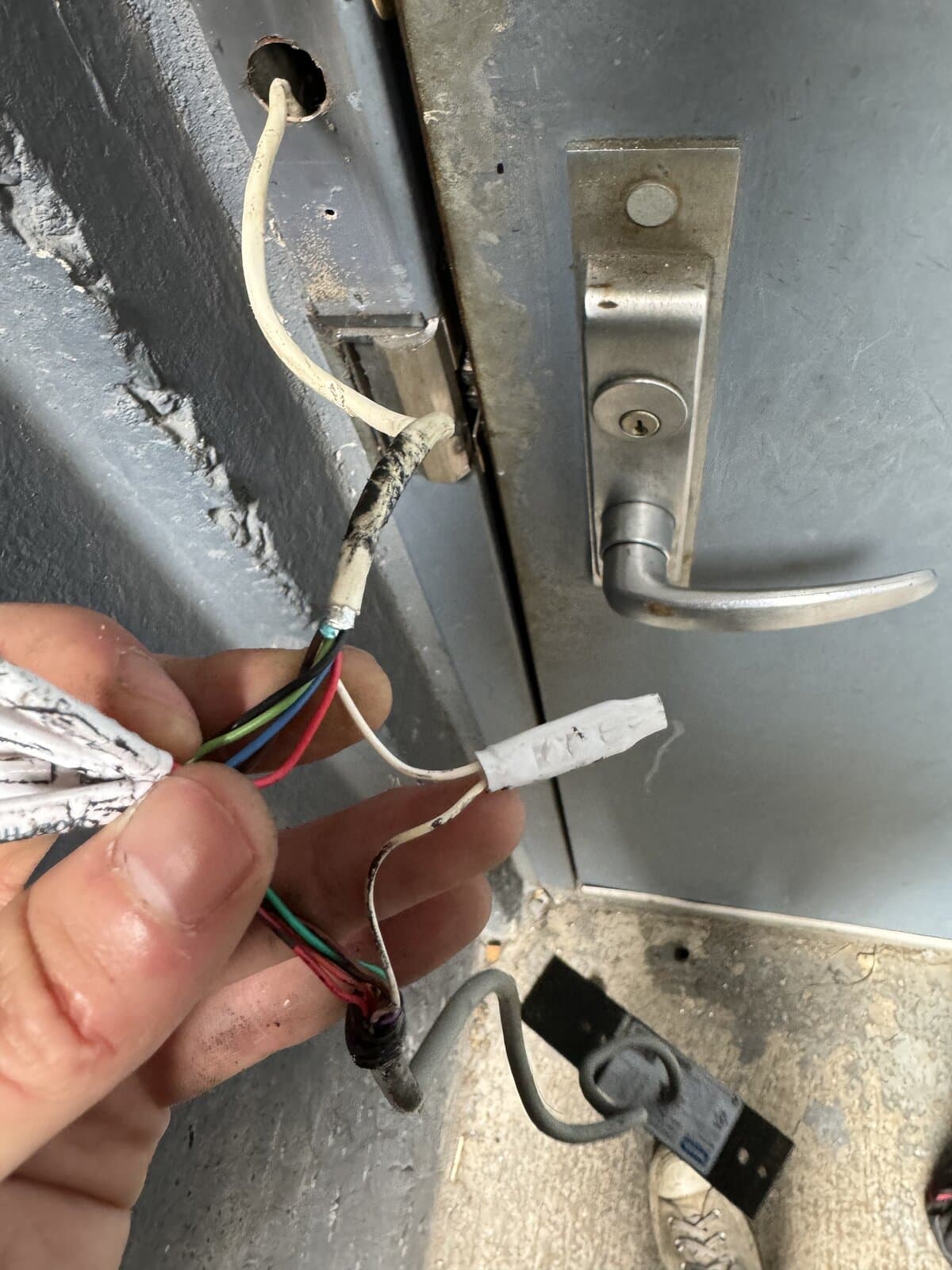
From there the tech works the riser from the panel side, checking continuity and shorts on the conductors serving the dead apartments. Old NYC systems are mostly simple analog circuits, which is good news: they can be tested conductor by conductor with basic instruments, and the fault can usually be localized to a floor or a segment. Only after the panel and riser check out does it make sense to go into an apartment and open the station itself. A tech who starts by quoting a new system without opening the panel hasn't diagnosed anything.
Single-apartment failures: usually the station, sometimes the branch
When one apartment can't hear, can't talk, or can't buzz the door, the usual suspect is the apartment station — the handset or wall unit inside the apartment. Decades of paint seal the buttons, the talk-listen switch contacts oxidize, handset cords break internally, and renovations knock stations off the wall and reconnect them wrong or not at all. These are bench-level repairs: clean or replace the station, re-terminate the wires, done in one visit if a compatible station is available. Compatibility is the catch — some legacy brands are still supported with replacement stations, others are long gone, and an orphaned system can turn a five-minute station swap into a hunt for salvage parts.
The other single-apartment cause is the branch: the short wire run connecting that apartment to the riser. A nail from picture-hanging, a renovation, or simple corrosion at a splice can kill one branch while the riser stays healthy. Symptoms like 'my neighbor's buzzer rings my apartment' or 'I can hear the lobby but they can't hear me' are classic crossed-or-broken-conductor signatures — one function per conductor is a rough but useful mental model for these old systems, so a single bad wire often kills exactly one function.
Dealing with this right now? We answer 24/7.
(347) 851-8615Building-wide failures and the riser problem
Whole-building failures usually trace to the panel zone: dead power supply, failed amplifier, corroded panel (street-facing panels live a hard life in NYC weather), or a door-release solenoid or strike that's mechanically worn out. All of these are repairable at reasonable cost, and 'the whole buzzer system is dead' frequently ends as a same-day fix. This is also the failure mode most worth calling in fast, because a building whose front door either won't lock or won't release is a security problem and an accessibility problem at once — it's a big part of why our line runs 24/7.
Riser faults are the harder category. A short or break inside a wall can't be repaired at the exact point without opening the wall, so the practical fix is rerouting around the bad segment or pulling replacement conductors through the existing path where possible. When failures accumulate — multiple bad segments, multiple crossed pairs, hum and crosstalk everywhere — the riser is telling you it's at end of life. That's the point where continued spot-repair becomes the expensive option, because each visit fixes one symptom of a wiring plant that keeps producing new ones.
Repair or replace: the honest decision logic
Repair wins when the fault is localized and parts exist: a dead transformer, a corroded panel, a broken station, one bad branch. Systems from major legacy manufacturers can often be kept running for years this way, and for a building that just needs its buzzer working, that's a perfectly good outcome. There is no rule that a 40-year-old intercom must be replaced — a simple analog system in decent wiring is remarkably serviceable.
Replacement wins in three situations. First, orphaned equipment: when the manufacturer is defunct and compatible stations can't be sourced, every future failure becomes a scavenger hunt. Second, degraded risers: when the wiring itself is the recurring fault, repairs are rent, not ownership. Third, when the building wants capability the old system can't offer — video at the door, smartphone access for deliveries — the repair-versus-replace question becomes an upgrade question, and money spent patching the old system is money not spent on the one you actually want. A useful test: if this is the third intercom service call in recent memory, ask the tech to price the current repair against a replacement path before authorizing more patchwork.
For landlords: the buzzer is a legal obligation, not an amenity
In New York City, a working front-door lock and intercom system isn't optional in most multifamily buildings. State multiple dwelling law and the city's housing maintenance code require buildings with eight or more units to have a self-closing, self-locking entrance door, and buildings covered by the intercom requirement must maintain a functioning two-way intercom with door release from each apartment to the main entrance. Maintenance is the operative word: HPD treats a broken buzzer or a non-latching entrance door as a condition to be corrected, tenants can and do file 311 complaints about it, and complaints ripen into violations with correction deadlines.
For owners and managers, the practical takeaway is to treat buzzer complaints with the same urgency as heat and hot water paperwork: log the complaint, get the repair scheduled fast, and keep the invoice as proof of correction. A dead intercom also quietly feeds other problems — tenants prop the front door open, which defeats the self-locking door requirement and invites package theft and worse. Downtown Door Repair & Security (NYC DCWP license #2109597) handles intercom diagnosis and repair across the five boroughs, 24/7, with offices at 170 Hicks Street in Brooklyn Heights and 232 Leonard Street in Williamsburg — and for recurring offenders, we'll tell you straight whether you're maintaining a system or subsidizing a dead one.